The triptych is one of the oldest compositional formats in Western art history. The word comes from the Greek triptychos - three-folded - and the format was established in Byzantine religious painting before finding its most elaborate expression in Flemish panel painting of the fourteenth and fifteenth centuries. Jan van Eyck, Hans Memling, Hieronymus Bosch: the triptych was the format of choice for works that needed to be both monumentally unified and physically transportable, because the hinged outer panels folded inward to protect the central image during travel.
The format survived the transition from religious to secular art, from panel painting to canvas, from oil to photography. It survived modernism, which had every reason to reject it as a medieval inheritance. Francis Bacon painted three-panel works throughout his career - his Triptych 1976 is one of the definitive large-scale works in twentieth-century painting. The format survived because it solves a compositional problem that no single rectangle fully solves: how to create a work that is both monumental in scale and visually differentiated at close range.
Why Three Panels
There is a mathematical reason that three panels work better than two or four for most compositional purposes.
Two panels produce a symmetry problem. The viewer's eye is drawn to the central divide - the gap between the panels - because bilateral symmetry is a powerful perceptual attractor. Unless the composition is designed to exploit the central divide (as some diptych paintings deliberately are), two-panel works tend to read as a divided single image rather than a unified composition.
Four panels produce a scale problem and a resting problem. Four panels in a row or a 2×2 grid create a grid rather than a composition. The grid has a visual logic of its own - orderly, systematic - but it competes with any compositional logic the image itself might have.
Three panels have none of these problems. The central panel is the visual anchor. The two flanking panels extend outward from it, giving the composition room to breathe and move. The viewer's eye travels left, to the right, back to the centre - a triangular movement that activates the full width of the work without fragmenting it.
This is why the triptych format produces works that read as larger than their individual components. A single panel of the same dimensions would read as a focused, intimate object. Three panels of that dimension read as a room-scale statement.
The Triptych in Photography
The photographic triptych has a different logic from the painted one. In painting, the three panels can carry different subjects that are unified by compositional logic and palette - the outer panels of a Memling altarpiece might depict donor portraits while the central panel depicts the Virgin, and the unity is created by the shared gold ground and the arrangement of gazes. In photography, the three panels are typically three moments of a single subject - a landscape photographed in three horizontally adjacent frames, a portrait series, an architectural study.
The photographic triptych's defining problem is the seam. If three photographs are printed and hung as a triptych, the seams between them are visible, and the question is whether the seams read as a compositional element (as they do in some conceptual photography) or as a failure of continuous image (as they do when the intent was to produce a continuous panorama).
The digital triptych - where a single image is divided into three sections - has the same seam problem, plus the additional problem of arbitrary division. Dividing a single photograph into three equal sections produces panels that bear no particular compositional relationship to each other. The panel edges cut through whatever the image contains at those points.
The Triptych as a Three-Panel System
The format that avoids both problems - the seam problem and the arbitrary division problem - treats the three panels as three distinct images that are compositionally related rather than three sections of one image.
This requires designing the panels together. Each panel must have its own compositional logic - a centre of gravity, a visual dynamic, an internal structure that makes it readable in isolation. And each panel must also participate in the compositional logic of the group - shared palette, complementary movement, related motifs.
The classic example in contemporary practice is the botanical study triptych: three panels, each a different botanical specimen, sharing a colour palette, a rendering style, and a spatial scale. Each panel is complete as a single image - a study of fern fronds, a study of seed pods, a study of dried grasses. Together they read as a collection, a field study, a continuous investigation.
The Rothko comparison is instructive here too. Rothko painted many multi-panel works. His Seagram Murals, now split between the Tate and the Museum of Fine Arts Houston and the National Gallery in Washington, were designed as a room installation - fifteen large-format canvases that were to surround the viewer in a continuous environment. Each canvas is a complete work with its own internal balance. Together they constitute something that could not exist in any single canvas.
This is the triptych at its most resolved: three objects that are also one object.
AI Generation and the Triptych Problem
AI image generation solves the compositional coordination problem that makes handmade triptychs difficult and expensive.
Asking a human illustrator to design three panels that share a palette, maintain consistent rendering, and compose correctly as both individual works and a group requires significant skill and time. The illustrator must hold all three panels in mind simultaneously - testing how each one reads in isolation, then testing how all three read together, then revising each panel in response to what the composition as a whole needs. This is not difficult creative work, but it is technically demanding work that requires multiple revision cycles.
A generation system that takes a single prompt and produces all three panels simultaneously can maintain the palette, the rendering style, and the compositional balance across panels as a default rather than as an achievement. The constraint that human illustrators must carefully apply - all panels must feel like they belong together - is built into the generation process.
The practical result is that a coordinated triptych is accessible at a price point that commissioned illustration cannot reach. This does not make AI-generated triptychs equivalent to commissioned illustration - they have different qualities and different limitations - but it makes the triptych format available to people who previously could not afford to commission it.
Where Triptychs Work in a Home
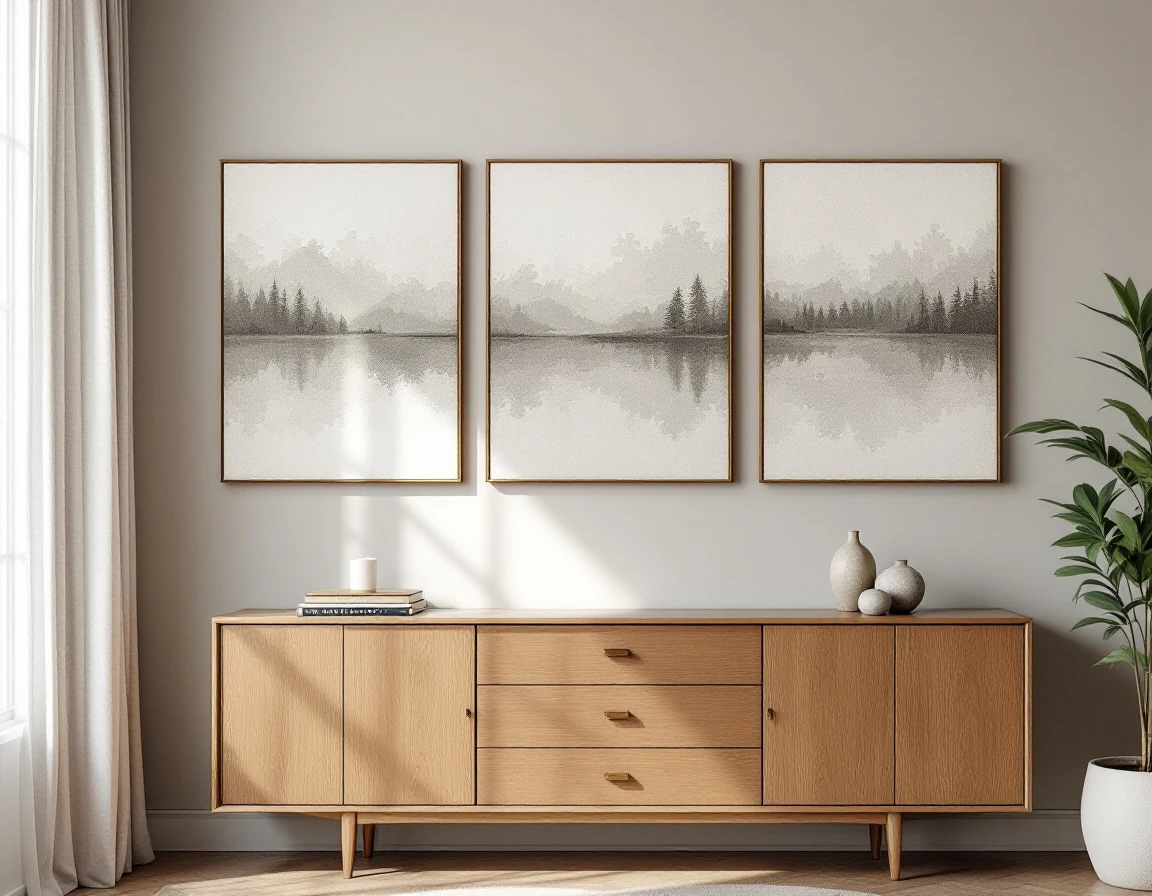
The horizontal strip triptych - three panels side by side - works above any horizontal furniture: a sofa, a bed, a console table, a credenza. The horizontal strip follows the furniture's logic and extends its visual weight upward without imposing on the room.
The proportions for a Triptych at standard panel sizes (530 × 390 mm per panel, with 30 mm spacing): approximately 1,650 mm wide by 390 mm tall. This is roughly the proportions of a widescreen photograph, or a panoramic landscape, or the horizontal register of a medieval altarpiece.
Above a sofa, this proportion is nearly perfect. The sofa's back is typically 90–105 cm from the floor. The triptych, hung with its lower edge 20–25 cm above the sofa back, sits at approximately 115–130 cm from the floor - centred in the visual field of a standing viewer and readable from seated.
The vertical strip - three panels in a column - works in narrow spaces: corridors, staircases, the wall beside a doorway. The vertical strip creates a visual interest in a space that has width limitations. It reads as a single tall object rather than three stacked ones.
The Object After the Assembly
A triptych of assembled puzzles, mounted as a gallery wall, is a different object from a triptych of framed prints.
The framed prints were printed, delivered, and hung. The assembly is not part of their history. The triptych of puzzles was assembled - each panel touched and fitted, piece by piece, over an evening or a weekend. The image was constructed rather than received.
This is not a claim about artistic value. It is a description of a different relationship between the viewer and the object. The person who assembled the Sediment Study triptych knows where the difficult section is - the section with low contrast, where the piece shapes were the only guide. They know which panel they finished last. The finished object on the wall is not just an image they chose. It is a record of a process.
The triptych format, three panels, has always worked because it holds attention differently than a single panel. Add the assembly dimension, and the object becomes something else again.
The Triptych is the entry tier of the Puzzably gallery wall - three 500-piece panels, generated from one prompt, designed to mount as a horizontal or vertical strip. Pricing starts at $135. The Studio takes any prompt you give it. See example triptych designs in the gallery.