The search query "how to display a finished puzzle" gets roughly 2,400 searches per month. This tells you something about the state of the puzzle market: a significant number of people are finishing puzzles, photographing them for Instagram, and then searching for what to do next. The industry has made the puzzle easy to buy and assemble. It has made the display problem completely their own.
There are several things you can do with a finished puzzle. Some require tools and money. One requires neither. Here is an honest rundown of the options.
Option 1: Glue and Frame
What it involves: Brush the assembled puzzle with puzzle glue (Mod Podge or a specific puzzle-saver product), let it dry flat for 24 hours, then mount it in a frame.
What makes it difficult: First, most puzzles are not standard frame sizes. A 500-piece puzzle at 530 × 390 millimetres does not fit a standard Ikea or off-the-shelf frame. You either need to find a frame that accommodates a slightly unusual size, or have one custom-made. Custom framing typically costs $50–150 depending on the framer and the materials.
Second, puzzle glue changes the surface of the puzzle. The matte finish that makes the image readable during assembly becomes slightly shinier after gluing. The surface also tends to develop micro-bubbles and slight waviness if the glue is not applied perfectly flat. The finished object is less visually clean than an unglued puzzle.
Third, gluing is irreversible. Once glued and framed, the puzzle cannot be disassembled or stored in its original form.
When this makes sense: When you have a puzzle with a strong image that you are certain you want to live on a specific wall, and when you are willing to invest in custom framing.
When it doesn't: For most people, most of the time.
Option 2: Puzzle Saver Sheets
What it involves: Adhesive backing sheets designed to bond to the back of a completed puzzle, allowing it to be lifted as a rigid unit and hung without framing.
What makes it difficult: The sheets do not make the puzzle rigid enough to hang on a wall without warping over time - the puzzle is held flat by the adhesive but will eventually bow if hung vertically without frame support. The adhesive is also not fully reversible, though it is less permanent than brush-on glue.
When this makes sense: As a temporary solution for transport (getting the puzzle from the assembly table to the framer) or for short-term display flat on a surface.
Option 3: Display Flat on a Surface
What it involves: Assemble the puzzle on a large, rigid board (thin plywood or foam board cut to the puzzle's dimensions), then leave it assembled and display it flat on a table, shelf, or console.
What makes this work: No glue, no framing, no irreversible decisions. The puzzle is preserved in assembled form and can be taken apart and stored at any point.
What makes it difficult: A 500-piece puzzle occupies a surface area of 530 × 390 millimetres - a significant portion of most coffee tables or shelves. For ongoing display, this surface must remain dedicated to the puzzle. Books, objects, and other items must be kept away from it. For people who use their tables and surfaces actively, this is a significant constraint.
When this makes sense: In a dedicated studio or office space where a surface can be committed to the display. Also as a short-term solution while you decide what to do longer-term.
Option 4: Acrylic Slipcase Display
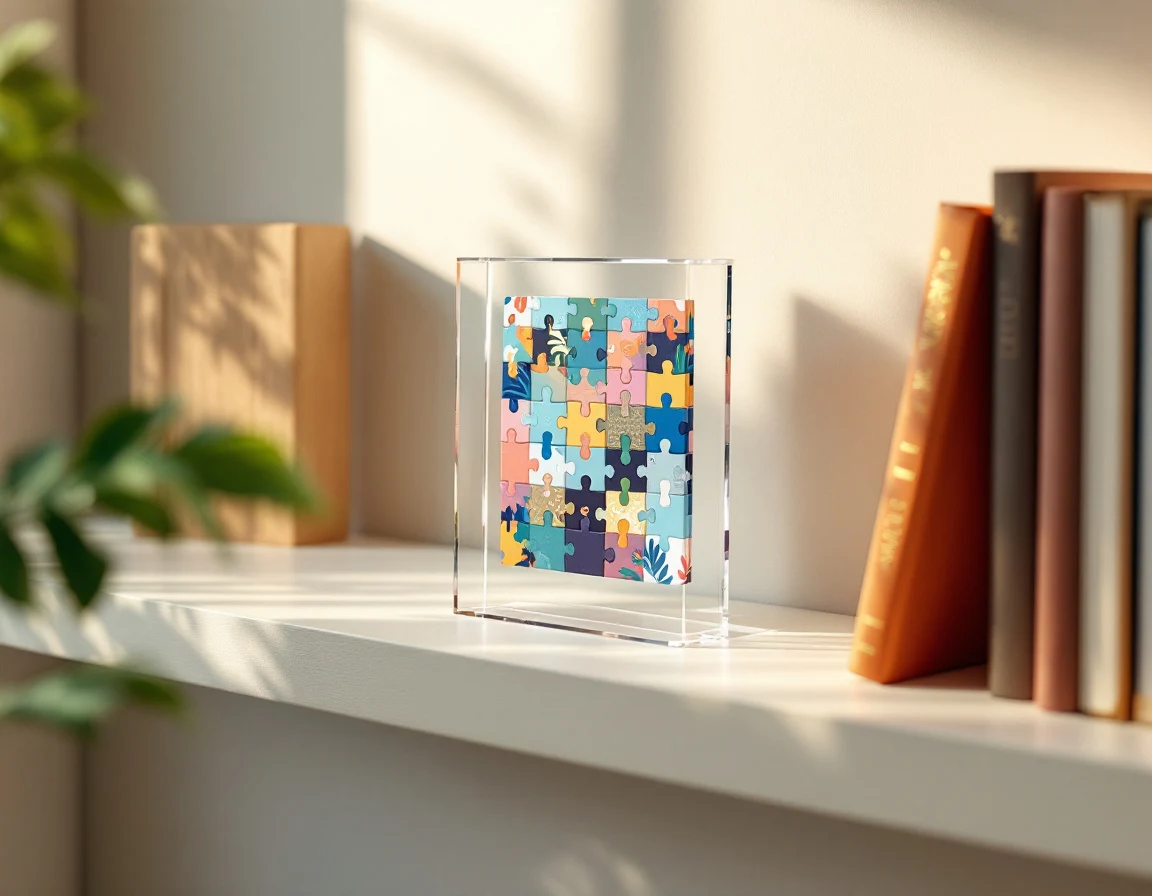
What it involves: A puzzle that ships in a clear, five-sided acrylic slipcase - protective storage that also functions as a display object. The assembled puzzle is not framed; it is slid back into the slipcase. The slipcase stands upright on a shelf, spine-out, like a record or a design book.
What makes this work: The display problem is solved by the packaging. There is no framing, no gluing, no dedicated flat surface. The assembled puzzle lives in the slipcase. The slipcase lives on the shelf. The puzzle is visible from the spine when the slipcase is closed, and fully visible when opened.
The slipcase also allows the puzzle to be taken out, used again, and returned - the display is reversible in a way that framing is not.
What makes it difficult: Not all puzzles ship with a slipcase. Most puzzles ship in a cardboard box, which cannot function as a display object. This option requires buying a puzzle from a company that offers it, or sourcing an acrylic slipcase separately (which is available from display-case suppliers but requires custom sizing).
When this makes sense: For any puzzle you are buying with display intent. Particularly for puzzles that arrive monthly - a slipcase system allows a growing collection to be stored and displayed as a coherent archive rather than a pile of cardboard boxes.
Option 5: Mount as a Gallery Wall Panel
What it involves: Assemble multiple coordinated puzzle panels and mount them together on a wall. Each panel hangs independently or from a shared mounting strip, arranged in a grid or strip.
What makes this work: For puzzles designed as coordinated sets - where all panels share a palette and were generated from a single compositional direction - the mounted result reads as a single large-format artwork. The scale is gallery-scale. The effect is substantial.
The mounting process does not require framing. Each panel can hang from standard picture-hanging hardware or clip into a mounting strip. The total cost of installation is significantly lower than professional framing of an equivalent large-format print.
What makes it difficult: Requires multiple panels designed as a set. Individual puzzles designed independently do not compose into a coherent gallery wall. The planning and installation take longer than hanging a single framed piece.
When this makes sense: When you want the finished result to function as a significant room feature rather than a single displayed object.
The Practical Hierarchy
For most people with most puzzles, the order of preference for display is:
- Acrylic slipcase, if the puzzle arrived with one.
- Flat display on a dedicated surface, temporarily, while you decide.
- Glue and custom frame, if the image is strong enough to justify the investment.
- Gallery wall mounting, if you have or plan to have multiple coordinated panels.
- Puzzle saver sheets, as a transport solution rather than a display solution.
The gap between the first and second options is significant. A puzzle in a slipcase is a resolved object. A puzzle on a board on a shelf is an interim object. Most people, once they've experienced the difference, prefer not to be in the interim.
The Question Worth Asking Before You Buy
The display problem is easier to solve before you buy the puzzle than after.
Before you buy: ask whether the puzzle comes in packaging that allows display. If the answer is a cardboard box, you will face this question the moment the assembly is finished.
The best time to decide how you want to display a puzzle is when you choose the puzzle. If the display solution is built into what you buy, the decision is made.
Puzzably's panels ship with optional acrylic slipcases (+$15/panel). Gallery wall sets - Triptych, Hex, and Atelier - are designed to mount directly to the wall without framing. The Studio generates all panels from a single prompt, and the buy page covers add-on options. More display ideas are at /gallery.