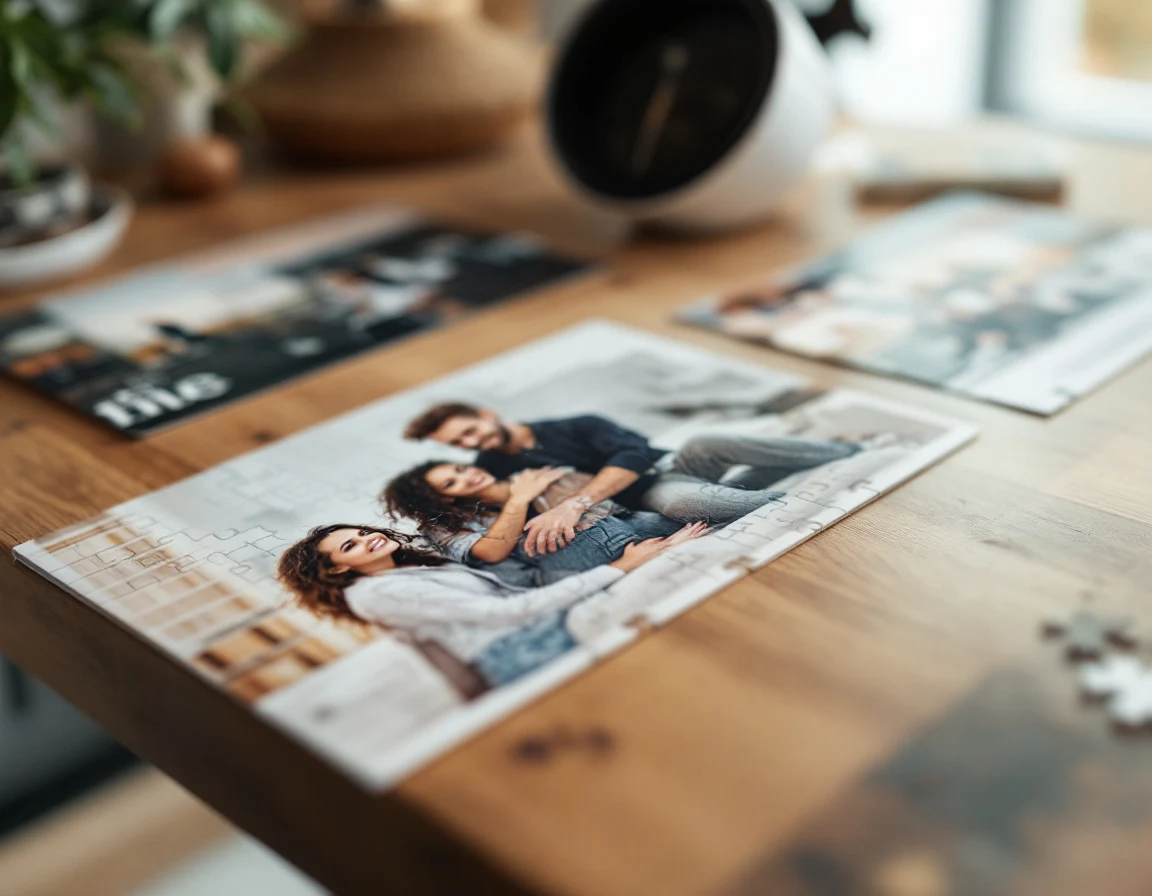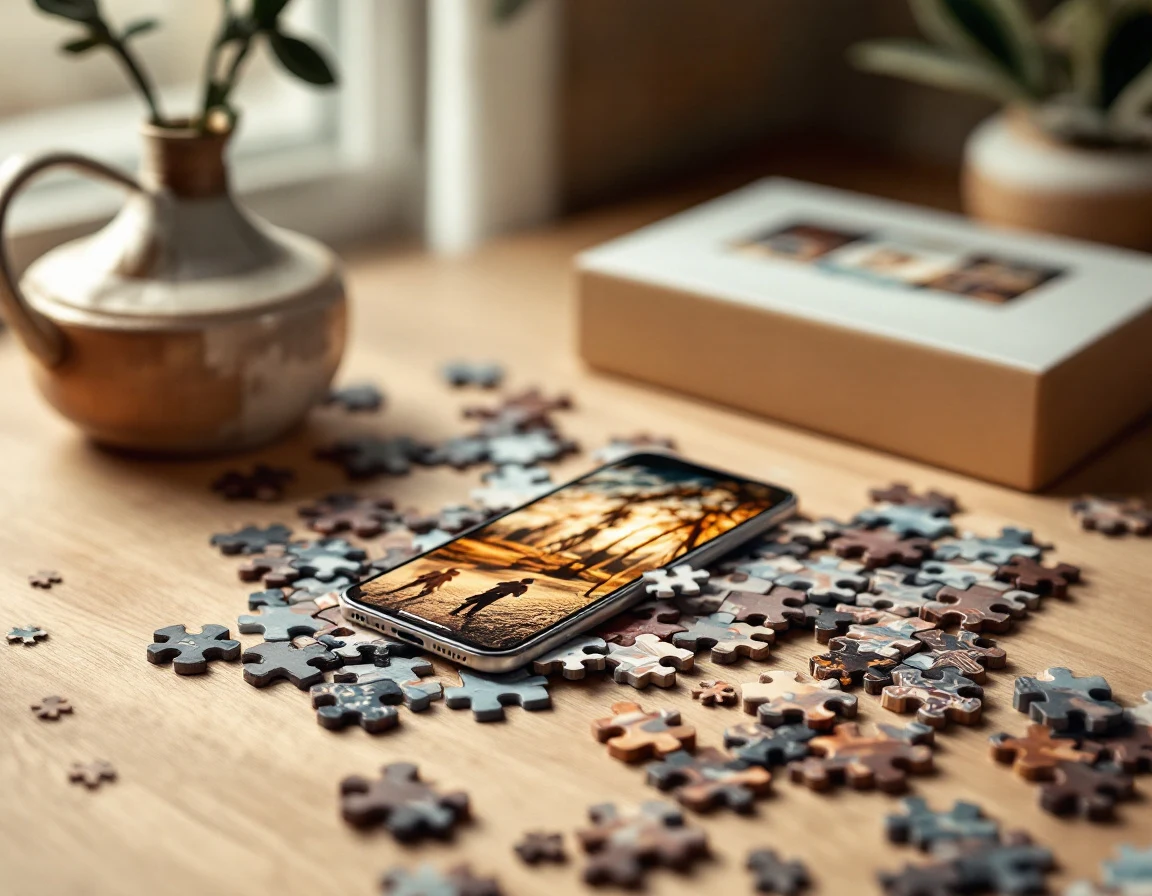
The idea is simple enough: take a photograph you love, send it to a company, receive a jigsaw puzzle of that photograph. You can do this in twenty minutes on a dozen different websites. The puzzle arrives, usually in a thin cardboard box, sometimes in a week, sometimes in three. You assemble it once, photograph it, and then face the question that the custom puzzle industry has not adequately answered: what do you do with it now?
This guide is about that question as much as it is about the process of getting a custom puzzle made. Because the photograph is the beginning of the object. What the object becomes - what it asks of you after it's assembled - depends entirely on what you bought and from whom.
What Makes a Good Custom Puzzle Photograph
Not all photographs make good puzzles. The problems are usually contrast and scale.
Contrast
A puzzle is solved by recognising where pieces belong. Pieces are recognised by their colour, their edge patterns, and the image fragments they carry. In sections of low contrast - a grey sky, a shadowed face, an overcast sea - pieces are visually indistinguishable. The puzzle becomes solvable only by edge shape, which makes it difficult and, for most people, not enjoyable.
High-contrast photographs - a subject against a clear background, a landscape with strong light-and-shadow separation, an architectural shot with defined geometry - produce puzzles with enough visual variation that every piece is findable. If you can identify the content of any given piece in isolation, the photograph will work well.
Subject and Framing
Close-up portraits of faces work well, with caveats. The detail is high. The contrast between skin, eyes, and background is usually workable. The finished puzzle looks like a portrait. The caveat is that faces are unforgiving in reproduction quality - a slightly soft focus or a high-ISO noise grain that is invisible at phone size becomes visible at puzzle size. Use the sharpest, most technically clean photograph you have.
Wide landscapes can work beautifully or fail completely, depending on whether the image has a clear focal subject. A mountain with a distinct peak, a beach with an interesting foreground, a skyline that reads as a silhouette: these work. A flat horizon-line landscape with even sky and even ground: these produce the most technically frustrating puzzles in the category.
Still-life photographs - objects on a table, a shelf arrangement, a flat-lay - are underused for custom puzzles and often produce the best results. Strong graphic compositions with clear objects and interesting colour relationships look exactly like contemporary art when assembled at 500 pieces.
Resolution
The minimum usable resolution for a 500-piece puzzle at standard print size (approximately 530 × 390 millimetres) is around 1,500 × 1,125 pixels, which is the native resolution of most smartphone cameras from 2016 onward. In practice, any photograph taken on a current smartphone in good light will be high enough resolution. The constraint is not megapixels - it's optical sharpness. A 50-megapixel photograph taken through a dirty lens in poor light will print worse than a 12-megapixel photograph taken in clean morning light.
How Most Custom Puzzle Services Work
The standard process at most custom puzzle companies is direct photo-to-print. You upload an image. The company prints it on puzzle board. The pieces are cut and put in a box. You receive the box.
This process is accurate to your photograph. It produces a puzzle that looks exactly like your photograph. This is both its strength and, for many uses, its limitation.
The limitation is not the quality of the reproduction - it's the nature of photographs. Most photographs are taken to capture a moment, not to be displayed objects. They carry camera metadata: the particular colour cast of whatever light was present, the depth-of-field rendering of whatever lens was used, the compression artefacts of however many times the file has been shared. These qualities are invisible or irrelevant when the photograph is viewed at phone size in a photo app. They are visible, and often distracting, when the photograph is printed at 530 millimetres and assembled into a puzzle that will sit on a table for three hours while you stare at it.
The photograph of your dog in the garden, beloved on your phone, is a different object at puzzle scale. It is rendered in whatever colour the camera sensor decided the light was that afternoon. The grass is a particular, possibly strange shade of digital green. The shadow under the fence has lost detail. The image is accurate and disappointing in equal measure.
The Alternative: AI Interpretation
A different approach treats the photograph as a prompt rather than a master. An AI model looks at what you've given it - the subject, the mood, the composition - and renders an interpretation. The interpretation is not a copy. It is a version: the same subject with a controlled colour palette, an illustrative line quality, a level of detail that has been optimised for the puzzle format rather than for photographic accuracy.
The result looks less like a photograph and more like a print. The colours are intentional rather than incidental. The rendering has a quality that makes every section of the puzzle visually distinct - good contrast, clear tonal separation, deliberate composition. The finished object is one you might hang on a wall. The photograph it was derived from might not be.
This approach requires more from the person making the puzzle - they need to describe what they want, not just upload what they have - but it produces a different kind of object at the end. Not a reproduction of a memory, but an interpretation of one. A print that happens to be assembled.
The Display Problem, Again
Custom puzzle services rarely think about what happens after the puzzle is assembled. The box goes back on the shelf. The puzzle, if preserved, is typically rolled up in a puzzle saver mat and stored flat, or dissolved and returned to the box, or framed at considerable expense and inconvenience.
Framing a puzzle requires: gluing it (which is irreversible), backing it (which adds cost and time), framing it (which requires knowing what size frame to buy or having one custom-made), and hanging it (which means committing a wall to it). The total cost of framing a custom puzzle, done properly, is usually higher than the cost of the puzzle itself. Most people don't do it. The puzzle goes in the box.
The design problem is that the puzzle - particularly a custom puzzle of an image you care about - is a display object without a display system. It is the size and shape of something you would hang on a wall or put on a shelf, but no one has built the thing that makes that easy.
What to Look For When You Buy
If you're buying a custom puzzle to give as a gift or to keep, here is the honest short list:
Image quality control. Does the company review your image before printing, or is it fully automated? A service with human review will flag problems - low resolution, poor contrast, subjects that won't read at puzzle scale - before printing something you'll be disappointed by.
Board quality. Puzzle board varies significantly. The cheapest puzzles are printed on thin grey chipboard that flexes when assembled and de-laminates over time. Better puzzles use ESKA board or similar archival-quality material that is stiff, holds its shape, and doesn't yellow.
Piece count. 500 pieces is the format that produces the best display-to-difficulty ratio. 250 pieces looks sparse and finishes in under an hour. 1,000 pieces produces a large, heavy assembled puzzle that is difficult to preserve and difficult to display.
What happens after. Does the puzzle ship with anything that makes display possible? A slipcase, a frame, a storage solution? Or is it a cardboard box and a bag of pieces?
The image itself. Is what you're ordering a direct print of your photograph, or does the company add any interpretive layer? Neither is wrong. They produce different objects.
Custom Puzzles as Gifts
A custom puzzle is a strong gift when the image is genuinely specific to the recipient. "A photo of us" is broad. "A photo from the trip we took to the coast in 2024, the one where the light was extraordinary" is specific. The more particular the image, the more the gift says that you paid attention.
The wrapping matters more for custom puzzles than for most gifts, because the outside of the box is the first thing the recipient sees. A thin cardboard box with a thumbnail of the image glued to it does not communicate that the object inside is considered. A slipcase with a printed spine communicates the same way a well-bound book communicates.
If you are giving a custom puzzle as a significant gift - for a milestone birthday, an anniversary, a wedding - it is worth buying from a company whose packaging matches the intent of the gift.
The Practical Summary
To get a custom puzzle worth keeping:
- Use a photograph with strong contrast and a clear subject. Test it at high zoom on your screen to check sharpness before uploading.
- Consider whether you want a direct print of your photograph or an AI-interpreted version. Direct print is personal and literal. AI interpretation is more likely to produce something display-worthy.
- Ask what the puzzle comes in. The packaging is not incidental - it determines what the object becomes after it's assembled.
- Understand the board quality before buying. This is rarely listed prominently; it is often findable in the FAQ or by asking directly.
- Decide in advance what you're going to do with it when you're done. If the answer is "I don't know," buy something that solves that problem before you open the box.
The custom puzzle category has grown faster than it has matured. The products available range from cheap printed cardboard to genuinely considered objects. The difference between them is not the photograph - it's everything that happens around the photograph.
Puzzably's Studio takes any description you give it - a photograph, a place, a prompt - and generates a custom image for your wall. Each panel is a 500-piece puzzle on museum-grade ESKA board. See pricing for single-panel options and gallery wall sets. The gallery has example starting points if you want to see what the process produces.